The Devil Tarot Card Meaning
The Devil
Pamela Colman Smith, 1909
- Upright
- attachment · temptation · shadow self
- Reversed
- release · breaking free · awareness
- Arcana
- Major · Number XV
- Element
- earth
- Learn it in
- Day 16 of the 30-Day Tarot Path
In short
The Devil is the card of habits that hold on. Upright, it asks you to look at what has a grip on you: a craving, a fear, a phone you cannot put down. Reversed, it points to loosening that grip. Its most hopeful detail is easy to miss: the chains on the card are loose enough to lift off.
What you see on The Devil card
Look first, read later: this is the Image-First Method from Day 5 of the course. Start with what is actually in the picture.
- Figure
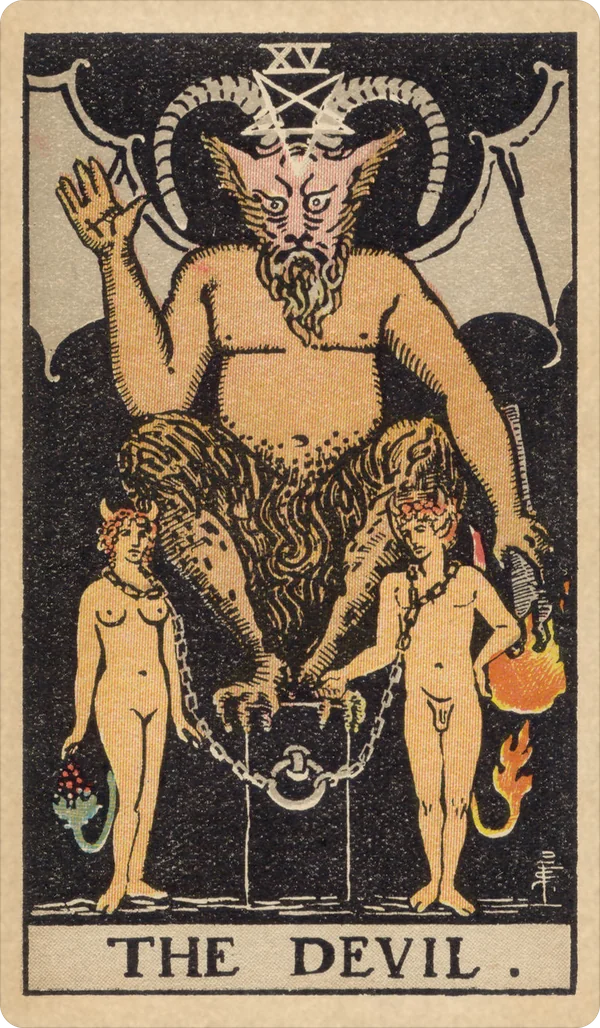
- A large horned creature with a goat’s face, bat wings and furry legs crouches on top of a black stone block. An upside‑down five‑pointed star sits on its forehead.
- Action
- The creature raises its right hand with the palm open and holds a burning torch pointed downward in its left hand.
- Setting
- Two nude human figures, a woman and a man, stand on either side of the block. Each wears a chain around the neck that runs back to a single ring on the stone.
- Color
- The background is nearly solid black, which makes the pale bodies and the orange flame stand out sharply. There is no sky, no horizon and no way out shown.
- Detail
- The two people have small horns and tails of their own. The woman’s tail ends in a cluster of grapes, and the man’s ends in a flame, as if they are slowly becoming like the creature above them.
The Devil upright meaning
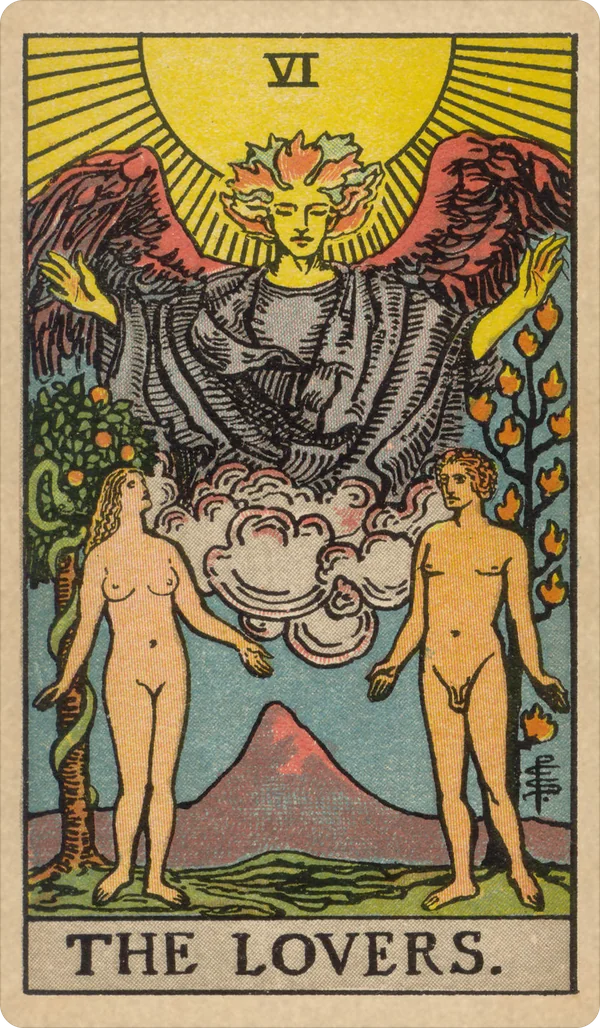
This card is a deliberate echo of The Lovers. Same two people, same placement, but the angel has been replaced by a horned figure and the open landscape has gone dark. Pamela Colman Smith seems to ask a sharp question: what happens when love, pleasure or comfort turns into something that controls you?
Upright, The Devil points to attachment. It can be a substance, a spending habit, endless scrolling, a job you hate but cannot imagine leaving, or a relationship where fear keeps you in place more than care does. It can also be a belief: I am not good enough, I always mess things up, this is just who I am. The card does not shame you for any of it. It simply asks you to name what has a hold.
Now look closely at the chains. They hang loosely around both necks. Either person could lift them off with two hands. The figures are not locked in; they have stopped noticing that they could leave. That is the real teaching here. Many of the things that bind us stay in place because they are familiar, not because they are unbreakable.
Ask yourself what you keep returning to even though part of you wants to stop, and what it gives you in return.
The Devil reversed meaning
In the reversed position, The Devil often marks the moment the chains start to feel heavy enough to notice. You may be ready to quit a habit, leave an unhealthy dynamic or stop believing an old story about yourself. That awareness is the first step, even if nothing has changed on the outside yet.
The reversal can also be a warning about swapping one attachment for another: quitting one habit and quietly picking up a new one, or leaving one controlling situation and walking into a similar one. The card asks you to look at what the old pattern was doing for you, so you can meet that need in a kinder way.
The Devil in love and relationships
Upright in love
In love, The Devil points to intensity and attachment. It can describe powerful physical chemistry, which is not a bad thing on its own. It can also point to jealousy, control, codependence, or staying with a partner because you fear being alone more than you enjoy being together. The card invites you to notice whether the bond leaves both of you freer or more restricted. Desire is part of being human; this card asks whether it is serving the relationship or running it.
Reversed in love
Reversed in love, The Devil can mark a turning point: noticing a toxic pattern, deciding to set a boundary, or seeing an on-again, off-again connection for what it is. It may also describe recovering after a relationship that felt consuming. The card asks you to be gentle with yourself as you step back. Loosening a strong attachment can feel like loss even when it is the right move, and the pull to return is often strongest just before it fades.
The Devil as feelings
As feelings, The Devil describes strong, hard-to-control emotion: obsession, desire, possessiveness or a sense of being hooked. In a connection, it asks you to notice how much of the pull is about the person and how much is about the rush itself. Is the feeling warm, or is it anxious? Do you feel more like yourself or less when you are together? Naming the difference between passion and compulsion can bring surprising clarity.
The Devil in career and money
In your working life, The Devil often points to feeling trapped: golden handcuffs, a toxic workplace, overwork you have convinced yourself is necessary, or a job kept only out of fear. It can also show up around money habits like impulse shopping, debt that keeps growing, or chasing status symbols. The card does not tell you to quit tomorrow. It asks what keeps you there, and whether that reason still holds up when you look at it in daylight. Small exits, like updating a resume, can loosen the grip.
The shadow side of The Devil
The Devil is the shadow card of the Major Arcana, so shadow work here is direct. It asks about the parts of you that you would rather not look at: cravings, envy, the wish to control, the urge to numb out. The goal is not to banish them. Shadow work means understanding what each one is trying to protect. Compulsive scrolling may protect you from loneliness. Control may protect you from chaos you lived through as a kid. Once you see the job a habit is doing, you can find a less costly way to do it. The two figures on the card are growing horns and tails. That is how shadow works when ignored: slowly, until it feels like part of who you are.
The Devil in yes-or-no questions
The Devil is often searched as a firm no, or as a sign of a toxic connection. In this practice, we don't use cards for yes-or-no verdicts. A question about your own part in the attachment gives you something you can act on, which is the point of this card.
Instead of
“Are they ever going to let me go?”
Try
“What keeps me attached to this situation, and what would it look like to lift the chain off myself?”
The Devil as advice
As guidance, The Devil says: name the hook. Write down one habit or pattern that controls more of your day than you want it to. Then write what it gives you, honestly, without judgment. Try one small experiment, like a single day without it, and notice what feelings come up in the space it leaves.
Journal prompts for The Devil
- What do I keep going back to, even though part of me wants to stop, and what does it give me in return?
- If the chain around my neck is as loose as the one on the card, what is actually keeping it there?
- Which part of myself have I been hiding because I am ashamed of it, and what might it need from me?
The Devil with other cards
- The Devil and The Lovers
The Devil and The Lovers mirror each other in the 1909 art. Together they ask whether a relationship choice is rooted in love and values or in fear and craving.
- The Devil and Eight of Swords
With the Eight of Swords, the focus is on limits you believe in more than they deserve. Both cards show restraints that are looser than they look.
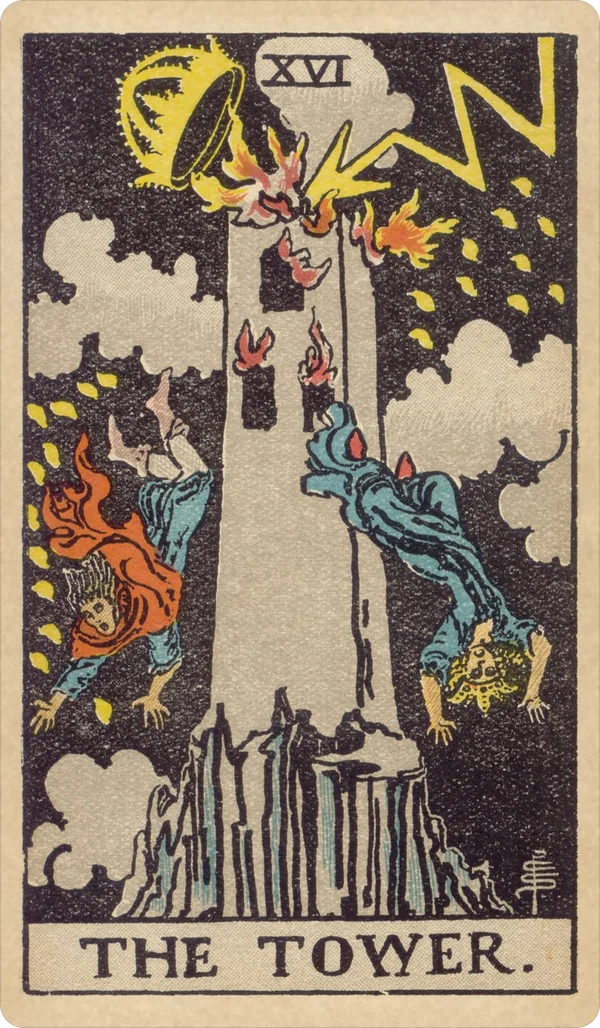
- The Devil and The Tower
The Devil followed by The Tower can describe a pattern that finally breaks under its own weight. Something built on an unhealthy foundation gets shaken loose.
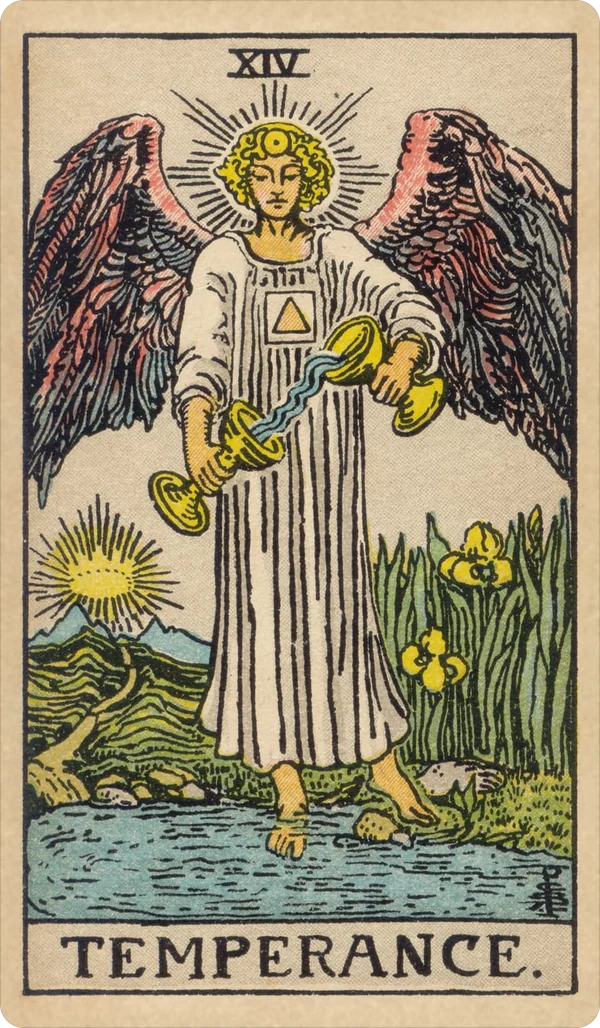
- The Devil and Temperance
Next to Temperance, the theme is moderation versus excess. The pair invites you to look for the healthy middle in a habit that has swung too far.
The most common misreading of The Devil
A very common fear is that The Devil means evil, a curse or a bad person in your life. Beginners on r/tarot often panic when they pull it. In the 1909 image, the horned figure is a symbol for the habits and fears that hold us, not a literal being. A second mistake is assuming that the card is all bad. It can also point to honest desire, playfulness and pleasure, as long as those choices remain yours.