Justice Tarot Card Meaning
Justice
Pamela Colman Smith, 1909
- Upright
- fairness · truth · accountability
- Reversed
- unfairness · avoided responsibility · dishonesty
- Arcana
- Major · Number XI
- Element
- air
- Learn it in
- Day 14 of the 30-Day Tarot Path
In short
Justice is the card of honest accounting. Upright, it asks you to weigh the facts, own your part, and act in a way you could explain to anyone. Reversed, it points to blame, self‑deception or a situation that feels unfair. It is less about a verdict from outside and more about your own sense of what is right.
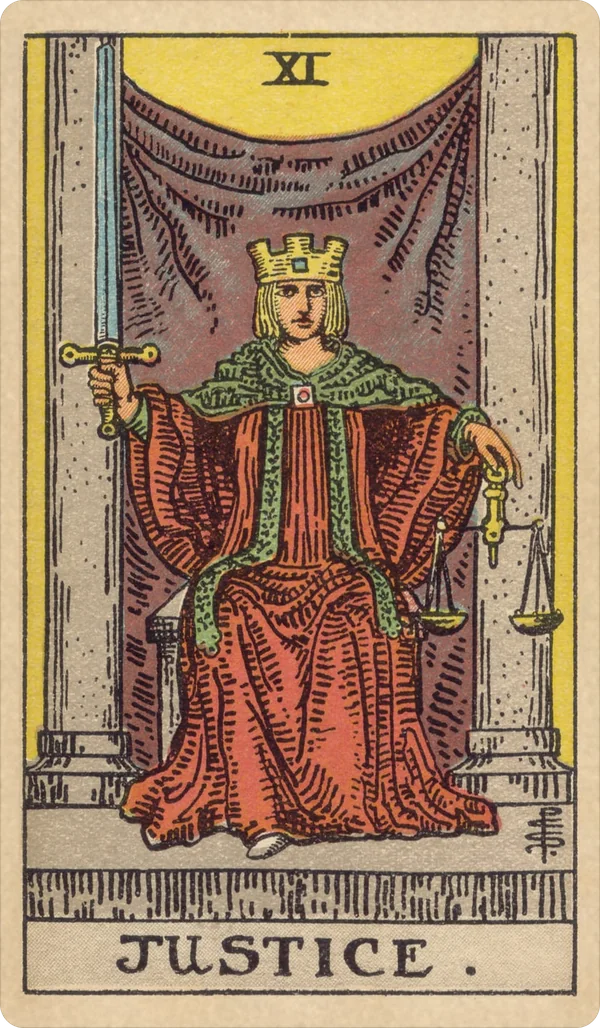
What you see on the Justice card
Look first, read later: this is the Image-First Method from Day 5 of the course. Start with what is actually in the picture.
- Figure
- A crowned figure in a long red robe and a green cloak sits facing straight out of the card. The eyes are open and calm, not blindfolded like the courthouse statue.
- Action
- The right hand holds a double‑edged sword pointing straight up. The left hand lets a set of golden scales hang loosely, balanced and at rest.
- Setting
- The throne stands between two gray stone pillars, with a purple curtain stretched behind it that hides whatever lies beyond.
- Color
- Above the curtain the sky is a flat, bright yellow. The red robe and the green cloak are the strongest colors, a classic pairing of action and growth.
- Detail
- A small white shoe peeks out from under the hem of the robe, as if the figure is about to step forward. The crown has a square jewel at its center, and a matching square clasp holds the cloak.
Justice upright meaning
Most people picture justice with a blindfold. Pamela Colman Smith drew this figure with eyes wide open, looking straight at you. That one choice changes the whole card. Justice here is not blind luck or a remote court. It is clear sight: seeing what actually happened, including your own part in it.
The sword stands upright, sharp on both sides. Decisions cut in two directions, and the card asks you to accept the consequences of what you choose as well as what others choose. The scales, meanwhile, hang still. They are not tipping. That stillness suggests a moment when the facts are on the table and it is possible to weigh them fairly.
Upright, Justice tends to appear around contracts, agreements, hard conversations and choices with a moral edge. It asks questions like: Am I telling the whole story? What would a fair outcome look like for everyone involved, not only for me? Where do I need to take responsibility instead of waiting for someone else to?
Notice the white shoe slipping out from under the robe. The figure is seated, but ready to move. Fairness is not only a judgment; it is an action you take afterward.
Justice reversed meaning
When it lands reversed, Justice often points to a blurry or uneven picture. Maybe you feel treated unfairly and the anger is justified. Maybe you are also avoiding a fact that complicates the story. The card asks you to separate the two.
This position can also describe harsh self-judgment: holding yourself to a standard you would never apply to a friend, or punishing yourself long after a mistake has been repaired. On the other side, it can mark a habit of shifting blame so you never have to sit with discomfort. Try writing down the situation as a neutral observer would. What is fact, what is feeling, and what is assumption? The answer usually shows which way the scales are tilted.
Justice in love and relationships
Upright in love
In love, Justice asks whether the give and take feels fair. Who plans the dates, who apologizes first, who carries the emotional labor of remembering birthdays and checking in? The card is not keeping score for you; it invites you to look honestly at the balance. It also points to clear agreements, whether that means defining the relationship, talking about moving in, or naming a boundary out loud so your partner does not have to guess it.
Reversed in love
Reversed in love, Justice can show up when one person is carrying more of the weight and resentment is quietly building. It may also point to old arguments that never got resolved, where each person holds their own version of events. The card asks you to notice where you are judging your person, or yourself, without all the facts. A calm conversation about what feels uneven often helps more than another round of who was right.
Justice as feelings
Justice as feelings is less about warmth and more about respect. When this card turns up in a question about feelings, it asks you to notice whether the connection feels fair and honest to you. Do you feel seen accurately, or judged? Are you both being truthful about what you want? The card points to a level-headed, careful kind of care, where people try to do right by each other even when emotions run high.
Justice in career and money
At work, Justice often appears around reviews, contracts, negotiations and anything involving rules or paperwork. It encourages you to read the fine print, keep records, and make the case for your work with facts rather than frustration. If you made a mistake, it asks you to own it plainly and fix what you can. With money habits, the card points to honest tracking: knowing what comes in and goes out, and making choices that match your values rather than your mood.
The shadow side of Justice
Seen from the shadow side, Justice is about self-righteousness. It is the voice that is sure it is right and wants the world to agree. Here the deeper task is noticing when fairness turns into punishment. Do you replay other people's mistakes for years? Do you need a clear villain in every conflict? Some people turn the sword inward instead, keeping a strict internal court where they are always guilty. Both patterns avoid the same thing: the messy middle where everyone is partly responsible. Notice also the purple curtain behind the figure. Some things are hidden from view, and Justice in shadow forgets that it cannot see everything.
Justice in yes-or-no questions
People often treat Justice as a sign that a decision will land in their favor. The Tarot Habit approach doesn't use cards for yes-or-no verdicts. Rewording the question keeps the focus on what you can see clearly and what you can do, which is exactly what this card is about.
Instead of
“Will the decision go my way?”
Try
“What would a fair outcome look like for everyone involved, and what is my part in getting there?”
Justice as advice
As advice, Justice says: tell yourself the whole truth, then act on it. Make a list of the facts before you react. If you owe an apology, give it without a but. If someone owes you one, ask for what is fair in plain words. Clear choices made in the open are easier to stand behind.
Journal prompts for Justice
- Where in my life am I telling only the part of the story that makes me look good?
- If a calm, fair friend looked at this situation, what would they say I am responsible for, and what is not mine to carry?
- The figure on the card is seated, but one foot is ready to step forward. What fair action have I been putting off?
Justice with other cards
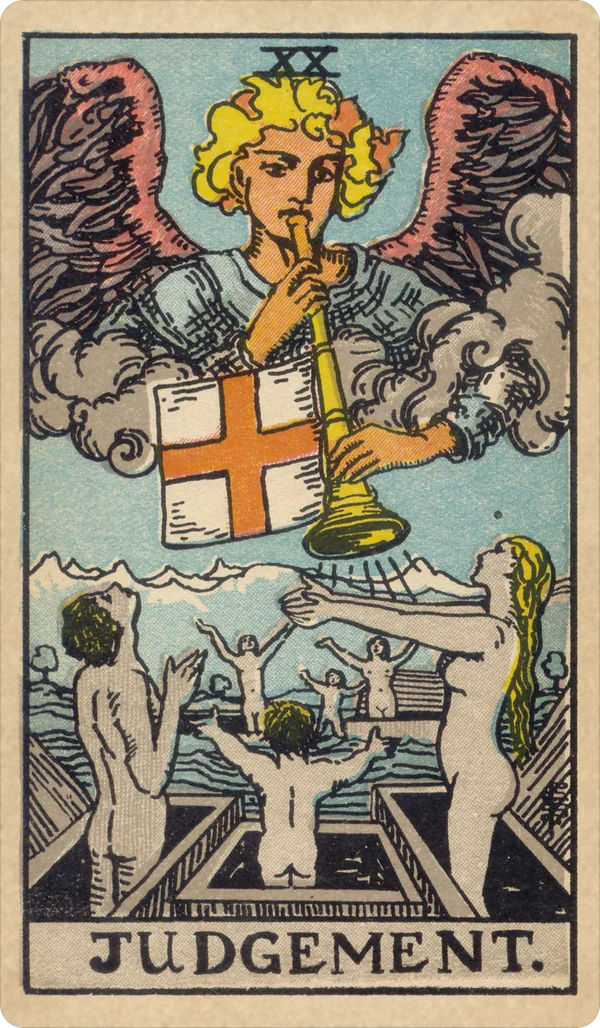
- Justice and Judgement
Justice with Judgement turns the focus to reckoning with the past. Together they ask you to review an old choice honestly and then decide who you want to be now.
- Justice and Two of Swords
With the Two of Swords, a decision is being avoided. Justice asks you to take off the blindfold that the Two wears and look at the facts directly.
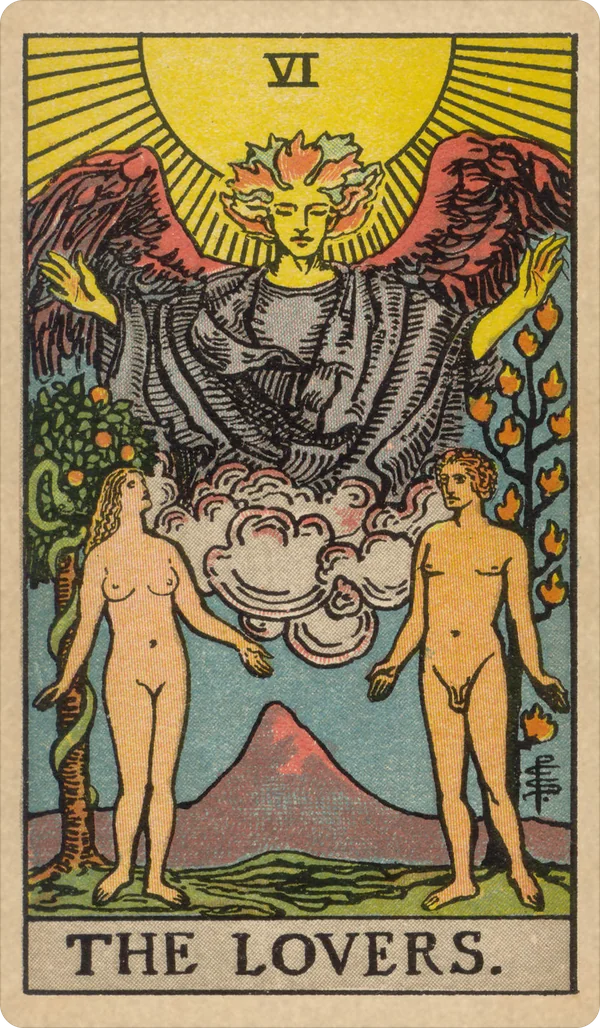
- Justice and The Lovers
Justice and The Lovers together put values at the center of a relationship choice. The question is not only what you feel, but what you can stand behind.
- Justice and Six of Pentacles
With the Six of Pentacles, the theme is fair exchange. Notice who gives, who receives, and whether the balance feels right to both sides.
The most common misreading of Justice
A popular misunderstanding is that Justice means a court case goes your way or that karma is about to punish someone who wronged you. Both turn the card into a cosmic referee. In the 1909 deck, the figure looks straight at the viewer, and the challenge is turned toward you. There is also the idea that the card is cold. Its open eyes suggest something more humane: fairness that comes from actually paying attention.