Six of Swords Tarot Card Meaning
Six of Swords
Pamela Colman Smith, 1909
- Upright
- transition · moving on · leaving behind
- Reversed
- resistance to change · unfinished business · turbulence
- Arcana
- Minor · Swords
- Element
- air
- Learn it in
- Day 23 of the 30-Day Tarot Path
In short
The Six of Swords is a quiet crossing from rough water to calmer water. Upright, it describes moving on, leaving a hard situation behind and heading toward recovery, even if you carry some sadness with you. Reversed, it points to a move that stalls, unfinished business, or baggage you keep bringing along for the ride.
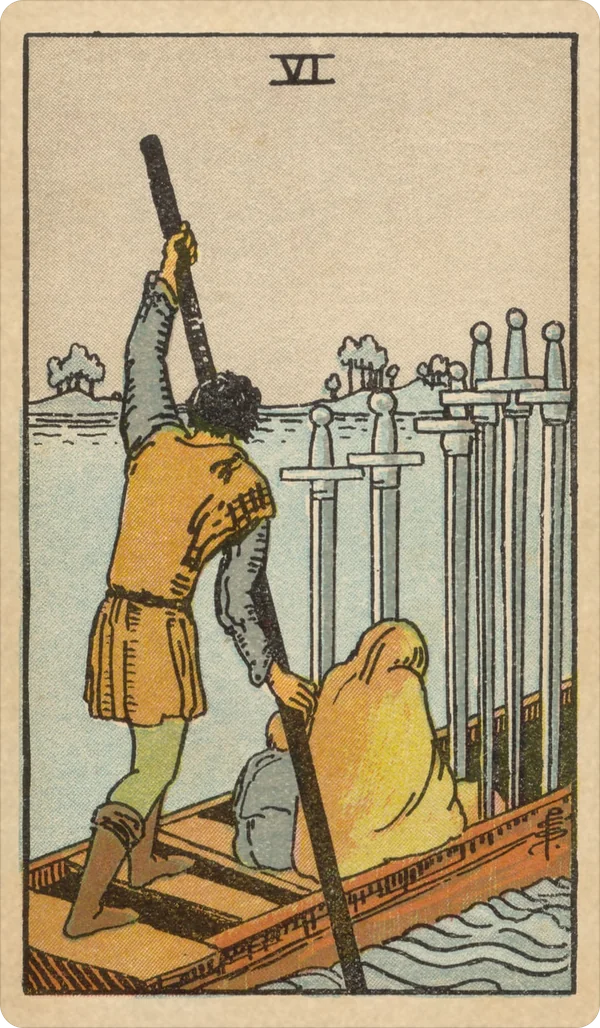
What you see on the Six of Swords card
Look first, read later: this is the Image-First Method from Day 5 of the course. Start with what is actually in the picture.
- Figure
- A ferryman in an orange tunic stands at the back of a small flat boat with his back to us. In front of him sit a hunched figure wrapped in a cloak and hood, and a smaller figure, likely a child, beside them.
- Action
- The ferryman pushes a long black pole into the water, steering the boat away from us toward the far shore.
- Setting
- Ahead lies a distant shore with a few trees. The water near the boat on the right is rippled, while the water further ahead is smooth and still.
- Color
- Muted grays and pale greens fill the background, with the warm orange of the ferryman’s tunic and the yellow of the passenger’s cloak in the foreground.
- Detail
- Six swords stand upright in the front of the boat, planted in its floor. The passengers travel with them, not without them.
Six of Swords upright meaning
This is one of the few cards in the suit where nobody is fighting, crying or trapped. The scene is about motion. A small boat is crossing water, and someone else is doing the steering. The passengers sit low, wrapped up and turned away from us, which is how many people look when they are leaving something painful.
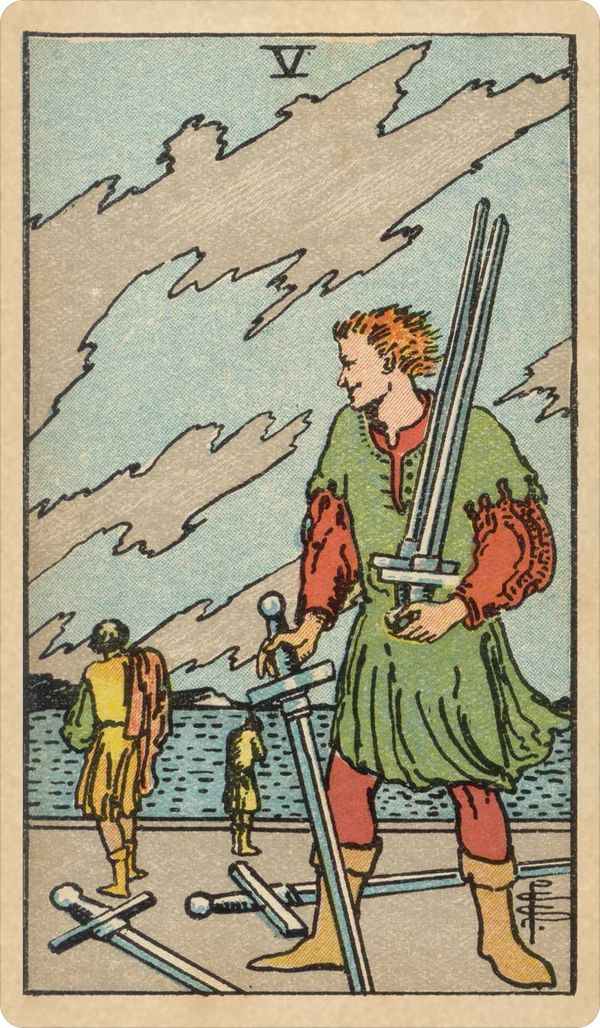
As the sixth step of the Swords, the card marks a turn. The conflict of the Five is behind. You might be moving out after a breakup, changing jobs after a rough year, or simply getting through the first stretch of recovery after a hard season. The Six of Swords does not say the sadness is gone. It says you are moving anyway.
Two details are worth a long look. First, the water: rough on one side of the boat, calm ahead. The card is honest that transitions begin in choppy water. Second, the swords: they ride along. The thoughts and memories from the old place come with you. They do not have to steer, but they are in the boat.
There is also comfort in the ferryman. You do not have to pole the boat yourself. Friends, family, a counselor or even a steady routine can carry you across. Ask who or what is helping you get to the other side right now.
Six of Swords reversed meaning
In the reversed position, the Six of Swords often describes a crossing that has stalled. You may know you need to leave a situation and keep finding reasons to stay on the old shore. Or you have already left, physically, but you keep looking back, checking in, reopening the same conversations.
The reversal can also mean the water is rougher than expected. A move or change is harder than it looked, and you feel unsteady. The card invites patience and honesty. What unfinished business needs to be settled before the boat can really move? Sometimes one closing conversation clears the way, and the boat starts to drift forward on its own.
Six of Swords in love and relationships
Upright in love
In love, the Six of Swords often points to moving on, gently. After a breakup, it can describe the slow process of building a calmer life, one where you think about the old relationship less each week. For couples, it may show the two of you leaving a rough patch behind together, perhaps through a real move, a new routine or a decision to stop fighting about the same thing. The card suggests that calmer water is reachable, even if you arrive a little tired.
Reversed in love
Reversed in love, the Six of Swords suggests emotional baggage coming along on the trip. You may be bringing an old hurt into a new relationship, or a couple might try to start fresh without dealing with what went wrong. It can also show feeling stuck on the shore of a relationship that has ended. The card invites you to notice which swords you are still carrying, and whether some of them could be set down before you go further.
Six of Swords as feelings
As feelings, the Six of Swords points to a quiet, somewhat sad sense of relief in the connection. There may be a feeling of leaving a hard time behind, mixed with tiredness and a little grief for what did not work. The card asks you to notice whether you are moving toward calm or just away from pain. Those can feel the same at first. Over time, the difference matters a lot for what kind of shore you reach.
Six of Swords in career and money
In your working life, the Six of Swords often appears during a job change, a team move or a slow recovery after a stressful project. It can describe relocating for work or shifting from a chaotic role to a calmer one. The card suggests accepting help with the transition: a mentor, a clear plan, a colleague who has made the same move. For money habits, it may point to moving away from a stressful pattern, like living paycheck to paycheck, toward steadier ground, step by step.
The shadow side of Six of Swords
In shadow work, the Six of Swords tends to bring up running away and calling it moving on. Leaving can be wise, and it can also become a pattern: new city, new job, new partner, same problem showing up again. The swords in the boat are the reminder. Whatever thoughts and beliefs you do not deal with tend to travel with you. Another shadow is the opposite: letting someone else always steer, never picking up the pole yourself. Shadow work with this card asks: What do I keep escaping instead of resolving? And where have I handed my direction to someone else because it felt safer? Notice that the passengers do not look at the shore they are leaving. Some things need one last look before you can let them go.
Six of Swords in yes-or-no questions
The Six of Swords is often read as a gentle yes to change. Tarot Habit does not give yes-or-no verdicts from the cards. The open question keeps you steering and helps you see what is in the boat.
Instead of
“Should I move away?”
Try
“What am I moving toward, what am I moving away from, and which thoughts would I bring with me?”
Six of Swords as advice
Pulled for advice, the Six of Swords invites a slow, steady crossing. Make one small move toward calmer water today, like packing a box, sending an update email or booking a first appointment. Let someone help with the pole. You do not have to know everything about the far shore to start rowing.
Journal prompts for Six of Swords
- What am I leaving behind right now, and what am I quietly taking with me?
- Who is my ferryman at the moment, and have I thanked them?
- What would calmer water look like in my everyday life?
Six of Swords with other cards
- Six of Swords and The Tower
After The Tower, the Six of Swords shows the move toward safety. Together they describe leaving a shaken situation and heading for steadier ground.
- Six of Swords and Eight of Cups
Eight of Cups is walking away alone; the Six of Swords is being carried across. Together they ask whether you need solitude or support for this move.
- Six of Swords and The Chariot
The Chariot drives forward on its own power. With the Six of Swords, it suggests taking a more active role in your transition.
- Six of Swords and The Star
With The Star, the far shore is a place of hope and healing. Together they show recovery that is gentle and real.
The most common misreading of Six of Swords
Many beginners assume that the Six of Swords always means a literal trip over water or a move abroad. It can, but more often it describes an inner crossing, from a hard state of mind to a calmer one. A related error is believing that it means you are leaving your troubles behind entirely. The six swords are still in the boat. The card is about carrying them differently.