Ace of Swords Tarot Card Meaning
Ace of Swords
Pamela Colman Smith, 1909
- Upright
- clarity · breakthrough · truth
- Reversed
- confusion · miscommunication · clouded judgment
- Arcana
- Minor · Swords
- Element
- air
- Learn it in
- Day 23 of the 30-Day Tarot Path
In short
The Ace of Swords is the moment a thought comes into focus. Upright, it points to clarity, a breakthrough idea, or a truth you can finally say plainly. Reversed, the same sharp mind turns into confusion, mixed messages or words that cut harder than intended. It is the seed of the whole suit of thinking.
What you see on the Ace of Swords card
Look first, read later: this is the Image-First Method from Day 5 of the course. Start with what is actually in the picture.
- Figure
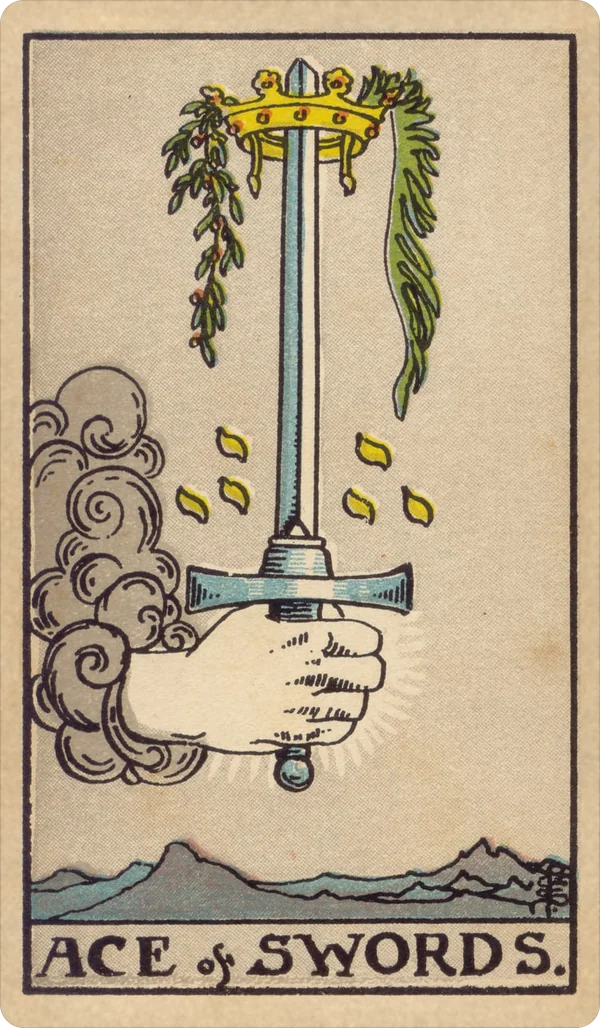
- A single white hand reaches out of a curling gray cloud on the left edge of the card and grips the hilt of a sword. There is no person attached, only the hand.
- Action
- The sword points straight up. Its tip passes through the middle of a gold crown, as if the blade has just risen into it.
- Setting
- Far below, a low band of blue‑gray mountains runs along the bottom of the card. Everything else is empty pale sky.
- Color
- The blade is a cool steel blue, set against the warm yellow of the crown and six small yellow drops floating beside it.
- Detail
- Two green branches hang from the crown: an olive branch with small red berries on the left and a palm frond on the right, old symbols of peace and victory.
Ace of Swords upright meaning
Every suit in the minor arcana starts with a hand coming out of a cloud, offering one object. Here the gift is a sword, and the sword stands for the mind: thoughts, words, decisions, the ability to cut through noise. As the first card of the suit, the Ace is pure potential. It is the clean idea before it has been argued with, the sentence before anyone has replied.
Upright, the card often appears when something suddenly makes sense. You finally see why a plan keeps failing, or you find the words for a feeling you have been circling for weeks. It can also point to a new subject or skill that grabs your attention. The crown at the tip of the blade suggests that clear thinking carries real authority. When you know what you mean, people tend to listen.
Notice the two branches, though. Olive for peace, palm for victory. A sharp truth can be used to make peace or to win a fight, and the card leaves that choice to you. The mountains below are rough and far away, a reminder that the hard part comes after the insight, when you have to carry it into ordinary life.
In a daily pull, ask what you already know but have not said clearly yet, even to yourself.
Ace of Swords reversed meaning
Turned upside down, the sword points into the ground and the crown falls away. Reversed, the Ace of Swords can describe a mind that is busy but not clear. Ideas pile up without one taking the lead. Conversations go in circles. You may say something true at the wrong moment, or in a sharper tone than you meant, and spend the rest of the day cleaning it up.
Sometimes the reversed card points instead to holding back a truth because you fear the reaction. The blade is still there; it just is not being used with care. Try writing the idea down before saying it out loud. Slowing the thought often restores its edge.
Ace of Swords in love and relationships
Upright in love
In love, the Ace of Swords invites honest, simple communication. It often shows up when a couple finally names the thing they have been talking around, or when someone single realizes exactly what they want in a partner and what they will no longer accept. The card favors clear words over hints. If you have been hoping your person will just guess how you feel, this Ace suggests saying it directly and kindly, then listening to the answer with the same openness.
Reversed in love
Reversed in love, the Ace of Swords can point to crossed wires. Texts get misread, a joke lands as an insult, or both of you are so busy defending your point that neither one hears the other. It may also reflect using words as weapons during an argument. The card asks you to notice whether you are trying to be understood or trying to be right. Those two goals feel similar in the moment and lead to very different places.
Ace of Swords as feelings
Asked as feelings, the Ace of Swords is less about warmth and more about clarity. In the connection, it may show a moment of seeing things as they really are, without the haze of hope or worry. That can feel like relief, or like a cold splash of water. The card asks you to notice whether you have recently understood something about this relationship that you have not yet admitted, and how it feels to hold that truth in your hands.
Ace of Swords in career and money
In your working life, the Ace of Swords is the card of the good idea. It can mark the start of a project, a fresh strategy, a pitch that finally clicks, or a moment when you see a problem clearly enough to solve it. It also rewards plain language: a sharp email, a short proposal, a clear no. If you are learning something new, this card favors study and focused practice. With money habits, it suggests looking at the actual numbers instead of the story you tell about them.
The shadow side of Ace of Swords
In shadow work, the Ace of Swords tends to bring up the belief that being right makes you good. A sharp mind is a gift, and it can quietly turn into a habit of cutting people down, winning every argument, or treating feelings as errors to be corrected. Some people hide behind logic because emotions feel messy and unsafe. Others hold back their clearest thoughts out of fear that honesty will cost them love. Shadow work with this card asks two questions: Where do I use the truth as a weapon? And where do I swallow the truth to keep the peace? The olive branch and the palm both hang from the same crown. Look at which one you usually reach for.
Ace of Swords in yes-or-no questions
The Ace of Swords is often read as a firm yes because it feels so decisive. Tarot Habit does not use cards as yes-or-no answers. Rewriting the question turns the card into a tool for finding your own words.
Instead of
“Should I tell them the truth?”
Try
“What exactly is the truth I want to share, and how could I say it so it is both honest and kind?”
Ace of Swords as advice
Pulled for advice, the Ace of Swords says: write one clear sentence. Name the decision, the boundary or the idea in as few words as possible. If you cannot say it simply, you probably do not understand it yet. Spend ten minutes getting it clear on paper before you speak.
Journal prompts for Ace of Swords
- What do I understand now that I did not understand a month ago?
- If I had to say my biggest current problem in one sentence, what would it be?
- When I tell the truth, do I tend to reach for the olive branch of peace or the palm of victory?
Ace of Swords with other cards
- Ace of Swords and The Magician
With The Magician, a new idea comes with the tools to act on it. Together they favor turning a clear thought into a first concrete step today.
- Ace of Swords and Two of Swords
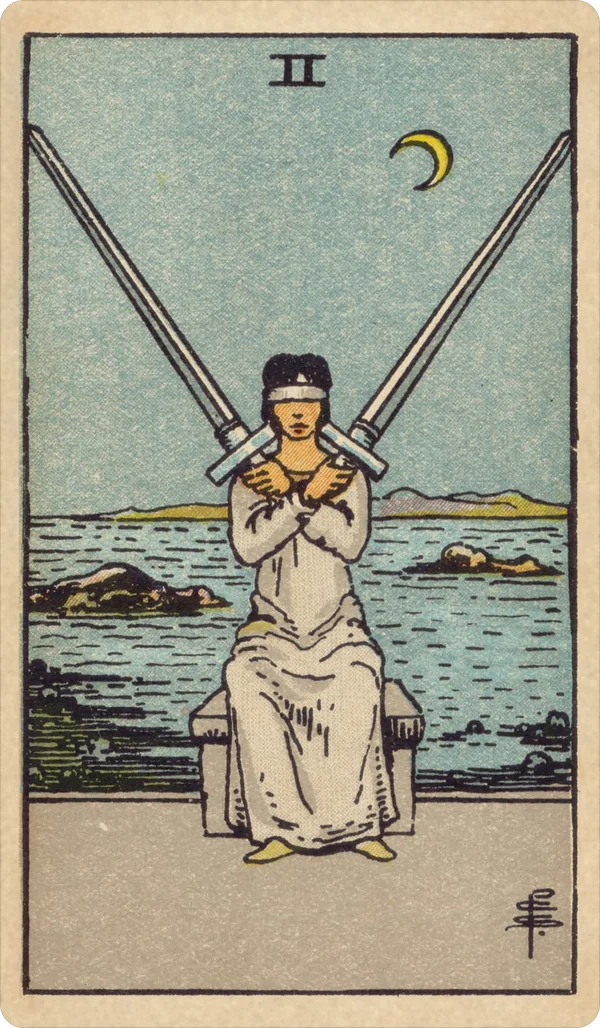
The Ace cuts and the Two hesitates. When they appear together, notice whether you already know the answer and are simply avoiding saying it.
- Ace of Swords and Ace of Cups
The Ace of Cups beside the Ace of Swords asks you to bring head and heart together. Clear words carry further when they come with real feeling.
- Ace of Swords and Justice
Justice and the Ace of Swords share the image of an upright blade. Together they point to a fair, honest look at the facts before you decide.
The most common misreading of Ace of Swords
A common beginner myth is that the Ace of Swords always means conflict, because swords look like weapons. Many new readers flinch at the whole suit. In the 1909 deck, this Ace wears a crown and carries branches of peace and victory. It is about clarity and truth far more than fighting. Another myth is that it means sudden news from outside. More often the breakthrough happens in your own mind.