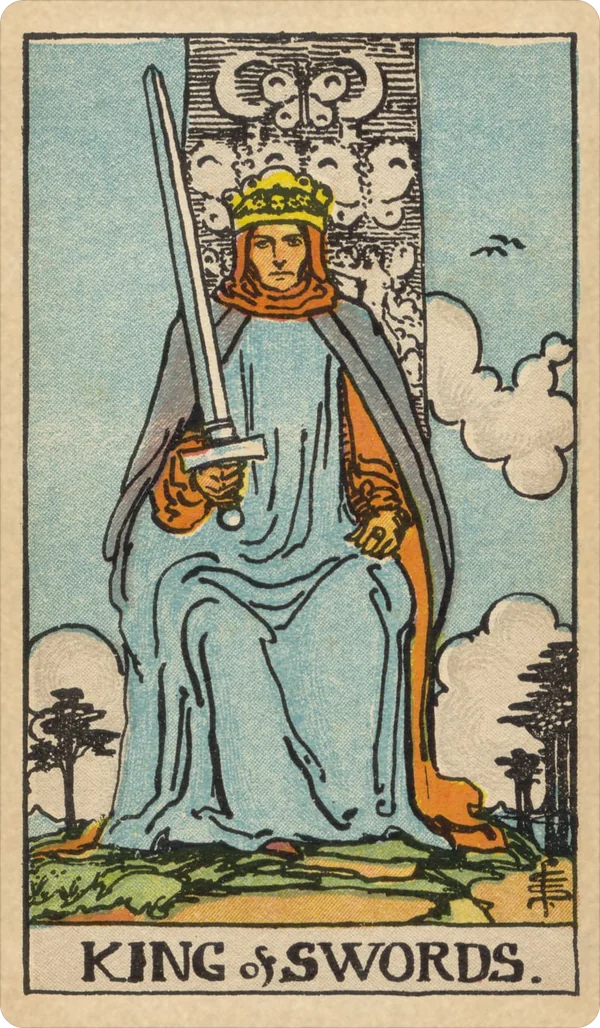
Five of Swords Tarot Card Meaning
Five of Swords
Pamela Colman Smith, 1909
- Upright
- conflict · winning at a cost · tension
- Reversed
- reconciliation · making amends · lingering resentment
- Arcana
- Minor · Swords
- Element
- air
- Learn it in
- Day 23 of the 30-Day Tarot Path
In short
The Five of Swords is the card of winning the argument and losing something bigger. Upright, it shows conflict, point‑scoring and victories that feel hollow. Reversed, it leans toward making amends, walking away or carrying resentment after a fight. It asks one sharp question: was being right worth what it cost?
What you see on the Five of Swords card
Look first, read later: this is the Image-First Method from Day 5 of the course. Start with what is actually in the picture.
- Figure
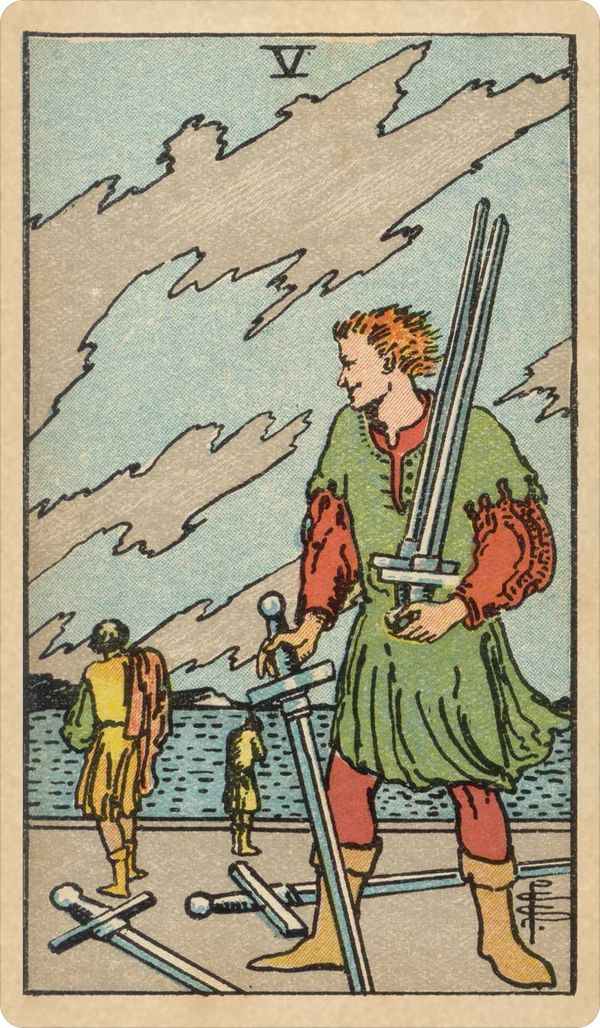
- A young man with messy red hair stands in the foreground in a green tunic with red sleeves and red stockings, looking back over his shoulder with a slight smirk.
- Action
- He holds three swords: two resting against his shoulder and a third pointed into the ground under his left hand. Two more swords lie dropped on the ground at his feet.
- Setting
- Two other figures walk away from him toward a stretch of water. The nearer one has his back turned, and the far one seems to have his face in his hands.
- Color
- A pale blue sky is torn by long, jagged gray clouds that slash diagonally across the card, giving the whole scene a windy, unsettled feel.
- Detail
- Look at his expression. He is not celebrating openly. It is more of a sideways grin, as if he knows the win was not quite clean.
Five of Swords upright meaning
Fives in the minor arcana break the comfort of the Four, and in the suit of Swords the break comes as a fight. The red-haired man has collected the swords of the others. He won. The two figures heading for the shore lost, and they are not coming back for their weapons.
The Five of Swords describes conflict where someone walks away diminished. It can be an argument you won by bringing up old mistakes, a group project where you took the credit, a family fight that ended in silence, or an online thread you could not stop replying to. It can also describe the other side: feeling outplayed, embarrassed, or tired of a fight that was never fair.
Notice those clouds. They are torn and sharp, like the mood after a nasty exchange. Nothing about the scene looks peaceful, not even for the winner. That is the lesson Pamela Colman Smith built into the image. Victory that leaves you alone with a pile of swords is a strange kind of prize.
Upright, this card invites you to ask which role you are playing, and whether the thing you are fighting about is worth the relationship it is costing. Sometimes it is. Often, it is not.
Five of Swords reversed meaning
Upside down, the Five of Swords tends to soften. The fight is over and someone is ready to talk. You might apologize, accept an apology, or decide that a conflict is not worth continuing and simply walk away from it with your dignity intact.
The reversal can also show resentment that lingers after the noise has stopped. You may still be replaying the argument in your head, writing better comebacks in the shower. The card invites you to notice whether you want repair or just a rematch. Laying down the swords is a choice, and it can be made even if the other person does not do the same.
Five of Swords in love and relationships
Upright in love
In love, the Five of Swords points to fights where someone keeps score. One partner may need to win every disagreement, or old mistakes keep getting dragged back into new arguments. It can also show sarcasm and cold jokes doing damage under the surface. The card asks you to notice whether you and your person are on the same team during conflict, or whether each argument feels like a match with a winner and a loser. Love rarely survives too many of those matches.
Reversed in love
Reversed in love, the Five of Swords leans toward repair. After a hard fight, someone reaches out first, or both of you agree to drop an old grudge. It can also mean choosing to leave a relationship where conflict has become the main way of relating. The card invites honesty about your part in the pattern. Saying I was unfair there is uncomfortable, and it often does more good than a hundred clever arguments.
Five of Swords as feelings
As feelings, the Five of Swords points to tension, defensiveness or wounded pride in the connection. One or both people may feel they lost something in a recent clash. The card asks you to notice whether you feel like the smirking winner, the figure walking away, or both at different times. Pride can mask hurt very well. Underneath many sharp words is a simple wish to be heard and respected.
Five of Swords in career and money
For work and money, the Five of Swords can show office politics, credit-taking or a competitive culture where people win by making others look bad. You might be in the middle of a disagreement with a colleague, or be tempted to cut a corner to get ahead. The card suggests weighing your reputation and long-term relationships against the short-term win. Some battles are worth leaving on the field. In money matters, it may point to a deal that benefits you but sours a connection.
The shadow side of Five of Swords
Look at the Five of Swords from its shadow side and you find the part of you that would rather be right than close. Everyone has it. It shows up as sarcasm, as the need for the last word, as keeping a mental file of every time someone else was wrong. Some people carry it differently: they never fight back openly, then quietly collect resentments until they can win later. Shadow work with this card asks: What does winning protect me from feeling? When did I learn that losing an argument meant losing respect? The man on the card holds three swords, but his hands are full. He cannot hold anyone else's hand at the same time.
Five of Swords in yes-or-no questions
People often expect the Five of Swords to be a no, or a yes with a catch. On Tarot Habit, we avoid using cards for yes-or-no answers. The rewrite turns a question about winning into a question about what matters.
Instead of
“Will I win this fight?”
Try
“What do I actually want from this conflict, and what am I willing to lose to get it?”
Five of Swords as advice
Taken as advice, the Five of Swords suggests choosing your battles. Before the next reply, ask whether you want to be right or to be understood. If it is the second, lead with curiosity instead of evidence. And if a fight cannot be fair, it is fine to walk away from it.
Journal prompts for Five of Swords
- When did I last win an argument and still feel bad afterward?
- In my current conflict, am I the one holding the swords or the one walking toward the water?
- What would I lose if I simply let this one go?
Five of Swords with other cards
- Five of Swords and Five of Wands
The Five of Wands is a messy group squabble, while the Five of Swords leaves people hurt. Together they ask whether a friendly rivalry has turned sour.
- Five of Swords and Strength
Strength next to the Five of Swords points to winning by gentleness instead of force. Together they invite calm confidence over sharp words.
- Five of Swords and Seven of Swords
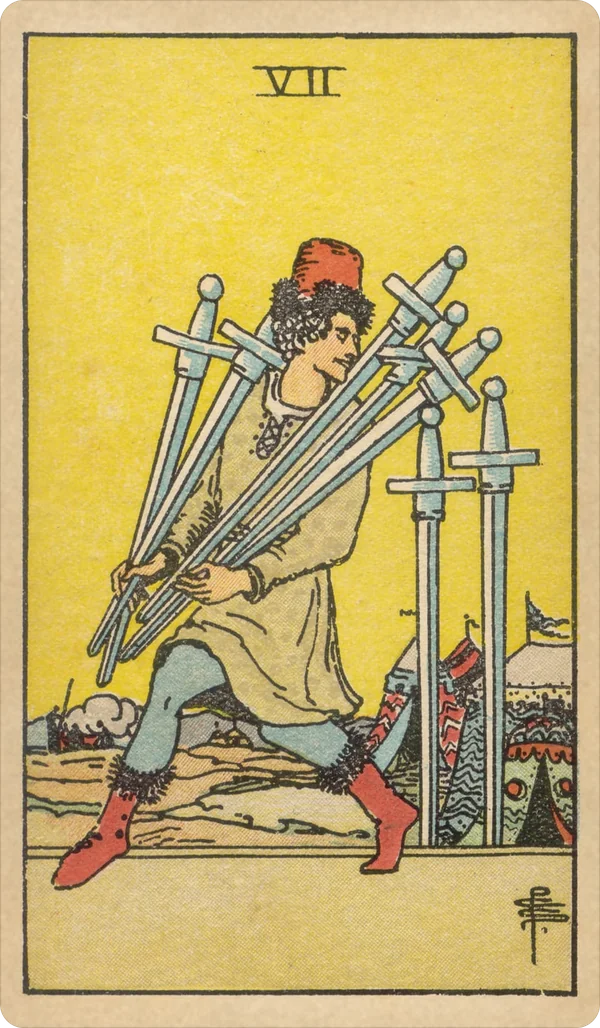
With the Seven of Swords, the theme is winning through sneaky tactics. Together they ask you to look honestly at how fair your methods are.
- Five of Swords and Six of Cups
The Six of Cups brings an old, kind memory into the conflict. Together they suggest remembering why the relationship mattered before the fight began.
The most common misreading of Five of Swords
A common beginner mistake is to assume you are always the loser in the Five of Swords. Many people see the figures walking away and identify with them right away. The card is just as likely to ask whether you are the one holding all the swords. Another myth is that it means violence. It is almost always about words, pride and power games.