Five of Wands Tarot Card Meaning
Five of Wands
Pamela Colman Smith, 1909
- Upright
- conflict · competition · friction
- Reversed
- avoided conflict · resolution · inner conflict
- Arcana
- Minor · Wands
- Element
- fire
- Learn it in
- Day 21 of the 30-Day Tarot Path
In short
Five young people swing wands at each other in a messy tangle, yet nobody looks hurt. That is the Five of Wands: friction, competition and clashing opinions, more scrimmage than war. Upright, it asks how you handle disagreement. Reversed, it points to conflict that is being avoided, turned inward, or finally cooling down.
What you see on the Five of Wands card
Look first, read later: this is the Image-First Method from Day 5 of the course. Start with what is actually in the picture.
- Figure
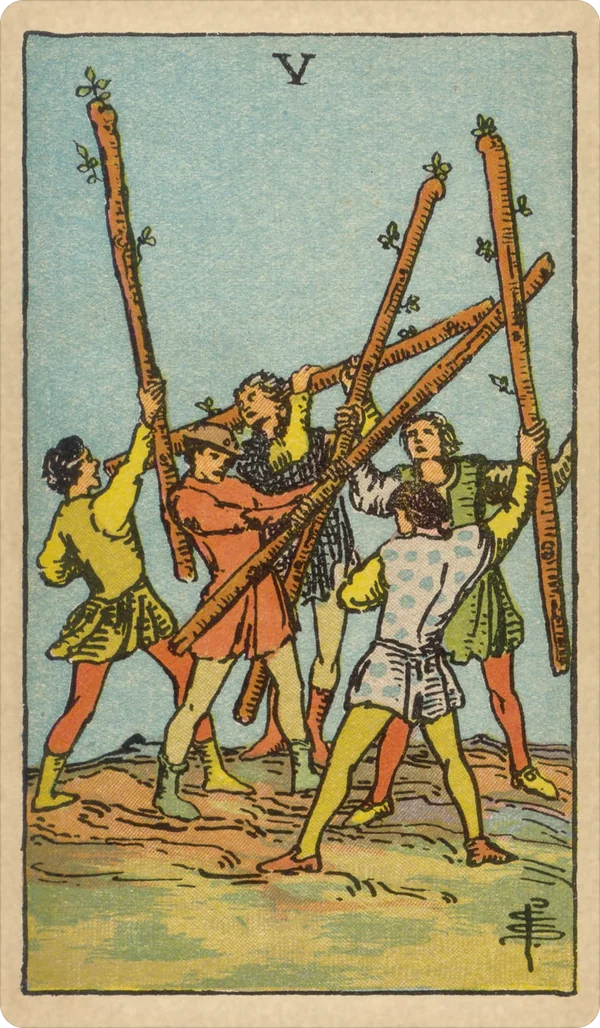
- Five young men in short tunics of different colors, yellow, red, gray, white with blue dots and green, crowd together on uneven ground.
- Action
- Each one raises a wand, and the five staffs cross in a chaotic web above their heads. It is hard to tell who is attacking whom, or whether they are fighting or practicing.
- Setting
- They stand on a bumpy brown and green patch of open ground under a plain blue sky, with no town or building in sight.
- Color
- Every figure wears a different color and pattern, which makes the group look like five separate teams in one small space.
- Detail
- There is no blood, no fallen body, and no clear winner. The man in the center even seems to be holding his wand up rather than striking with it.
Five of Wands upright meaning
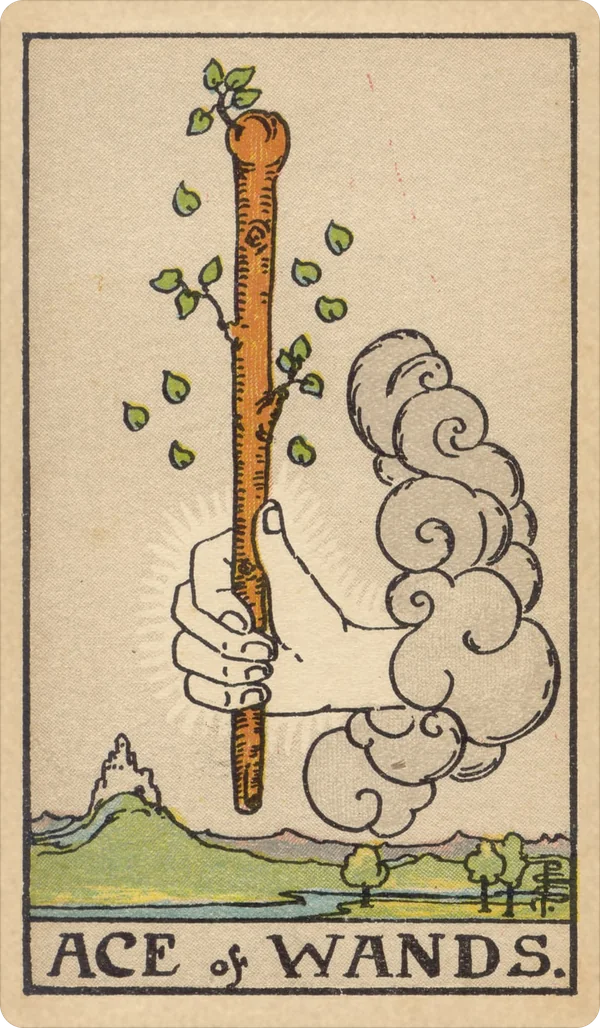
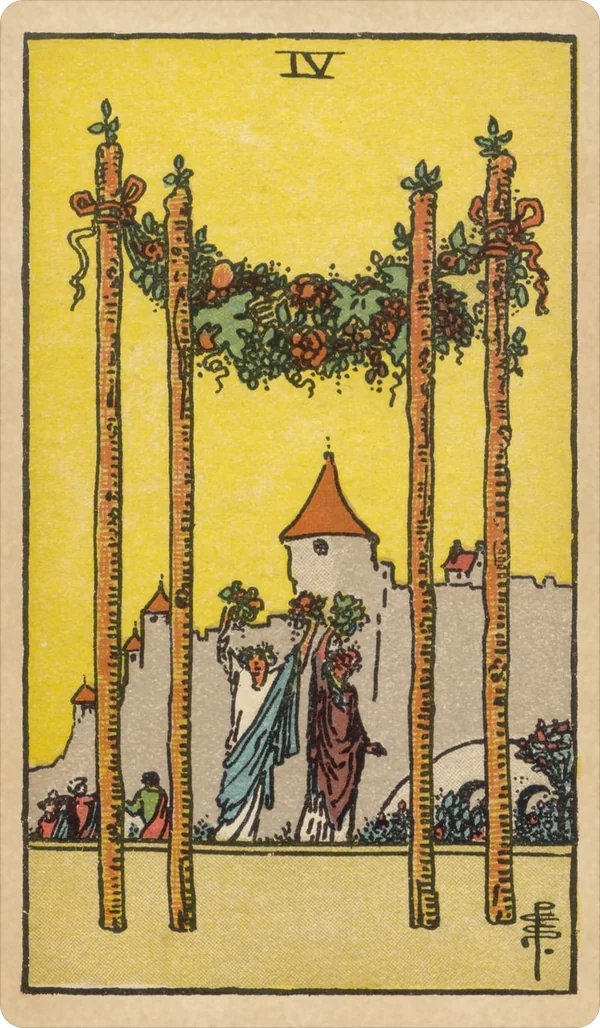
Fives in the minor arcana tend to bring disruption after the stability of the Fours. In the Wands, the celebration under the garland gives way to a noisy crowd of competing voices. Everyone has a staff. Everyone has energy. Nobody is aligned.
The key to this card is how unserious the violence looks. The figures are young, the poses are almost playful, and no one is losing. Many people see a sports practice or a group brainstorm that got loud. That is often how the Five of Wands shows up in life: a team meeting where every idea fights for the floor, a family chat that spirals into debate, a creative project with too many cooks.
Upright, the card invites you to notice the kind of conflict you are in. Is it a healthy clash that sharpens ideas, or friction that wastes energy because nobody is listening? Competition can push you to grow. It can also turn every conversation into a contest.
Ask what you are actually fighting for. In the picture, five wands cross but none of them point anywhere in particular. Sometimes the most useful move is to lower your own staff for a moment and ask what everyone in the circle wants.
Five of Wands reversed meaning
Reversed, the Five of Wands has two common faces. The first is avoidance. You might be dodging an argument that needs to happen, keeping the peace on the surface while resentment builds underneath. The second is internal: the five figures are all inside your own head, pulling you in different directions until you feel worn out.
The reversal can also be good news. A long-running dispute may be quieting down, or a group may be finding a way to cooperate. The card asks which of these fits. If the conflict is hidden, what would it take to name it kindly? If it is internal, which voice deserves the final say?
Five of Wands in love and relationships
Upright in love
In love, the Five of Wands often points to bickering, playful or not. Small disagreements about chores, plans or texting habits can pile up until every conversation feels like a debate. Some couples enjoy a bit of spark and teasing; others feel drained by it. For people dating, it may show several options or competing interests at once. The card invites you to notice whether your arguments are about the real issue, or whether you are fighting over the wand instead of the thing behind it.
Reversed in love
Reversed in love, the Five of Wands can describe a relationship where nobody says what bothers them, so the tension leaks out sideways in tone and silence. It may also show a couple moving past a rough patch and learning to disagree more gently. The card asks you to consider whether peace in your relationship is real or simply quiet, and what one honest conversation could change.
Five of Wands as feelings
Looking up the Five of Wands as feelings often comes from wanting to know why things feel tense with someone. Rather than guessing at the other person's mind, the card points you to the friction itself. Feelings here can include irritation, competitiveness, restless attraction, or the frustration of not being heard. Notice whether you feel energized by the push and pull, or whether part of you is tired of always having to win the conversation.
Five of Wands in career and money
In a career spread, the Five of Wands is the card of crowded rooms. It fits brainstorming sessions, competitive markets, team friction and job searches with many applicants. The card does not say the conflict is bad. Healthy debate can lead to better results, and competition can sharpen your skills. It asks you to check the rules of the game. Is everyone fighting for the same goal, or is this about ego? Clear roles and a shared aim often turn chaos into useful energy.
The shadow side of Five of Wands
The hidden edge of the Five of Wands is the need to win every exchange. Some of us treat disagreement as a threat to who we are, so we argue harder and listen less. Others love the drama of conflict because it feels like being alive, and quietly stir things up when life gets calm. A third shadow is the person who never picks up a wand at all, letting others shout while they disappear. Shadow work with this card asks: in a heated group, which of the five figures am I? What am I really defending when I refuse to let a point go?
Five of Wands in yes-or-no questions
Winning and losing are the wrong frame for this card, because nobody in the picture wins. A yes-or-no answer would only feed the contest. Reframing the question shifts your attention from the fight to what you want, which is the part you can do something about.
Instead of
“Am I going to win this argument?”
Try
“What do I actually need from this disagreement, and how can I ask for it clearly?”
Five of Wands as advice
The Five of Wands suggests lowering your staff before raising your voice. In your next tense conversation, try summarizing the other person's point before making yours. Notice how the energy in the room changes when someone feels heard. Friction does not have to disappear to become useful.
Journal prompts for Five of Wands
- Where in my life does it feel like five people are talking at once, and which voice is mine?
- When I argue, am I usually trying to be right, be heard, or be left alone?
- What disagreement have I been avoiding, and what would a calm first sentence sound like?
Five of Wands with other cards
- Five of Wands and Temperance
Beside Temperance, the Five of Wands asks for balance and patience. Together they point toward finding a middle path through a clash.
- Five of Wands and Five of Swords
With the Five of Swords, conflict turns sharper and more personal. Notice whether winning is costing more than it is worth.
- Five of Wands and Seven of Wands
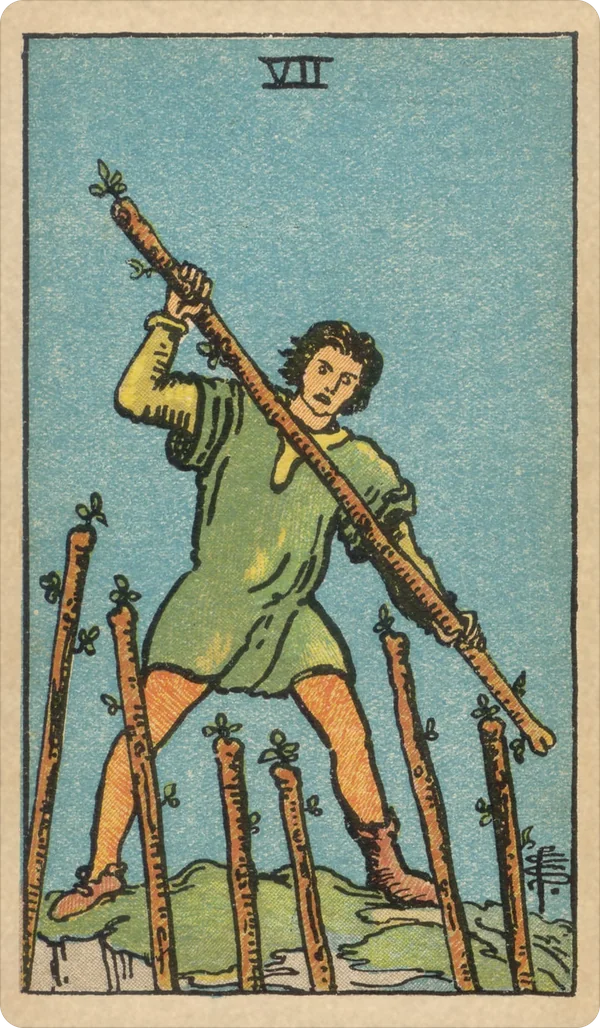
The Seven of Wands follows naturally: after the scrimmage, one person takes the high ground and defends their position.
- Five of Wands and Three of Cups
With the Three of Cups, the clash may be among friends. A playful rivalry can stay healthy if the friendship stays at the center.
The most common misreading of Five of Wands
Beginners are often told that the Five of Wands means a serious fight or the end of a friendship. Beginners see five people swinging sticks and expect disaster. In the 1909 card, though, nobody is injured and the scene looks closer to a game or a training drill. The card is about friction and competing energy, not violence. A second mistake is assuming that reversed always means peace; it can also mean conflict that has gone underground.