Ten of Pentacles Tarot Card Meaning
Ten of Pentacles
Pamela Colman Smith, 1909
- Upright
- legacy · family · long‑term stability
- Reversed
- family conflict · instability · lost legacy
- Arcana
- Minor · Pentacles
- Element
- earth
- Learn it in
- Day 24 of the 30-Day Tarot Path
In short
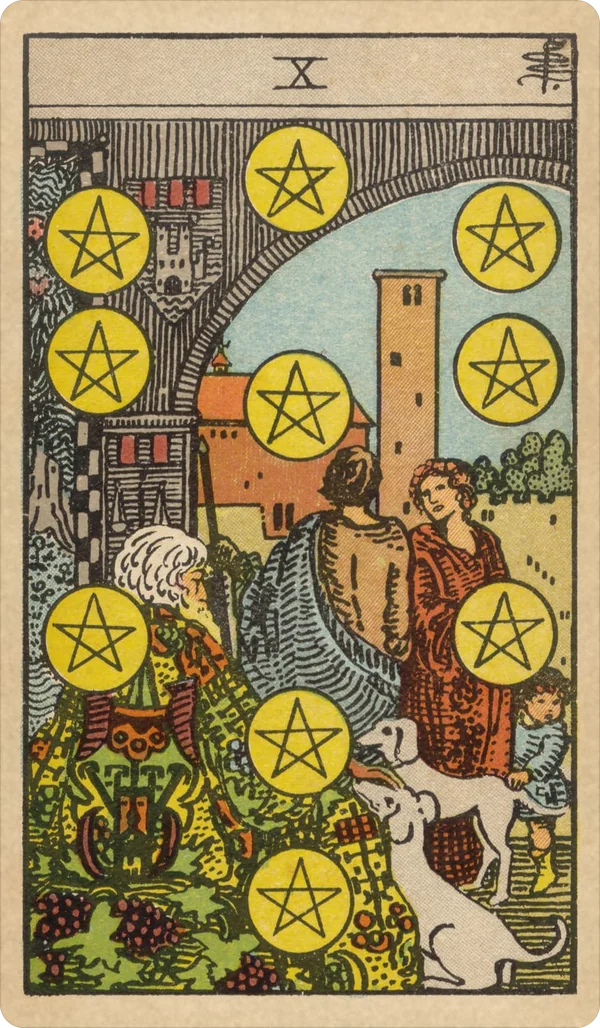
The Ten of Pentacles shows three generations and two dogs gathered at the gate of an old family estate. It completes the suit of earth: roots, belonging and what lasts beyond one lifetime. Upright, it honors legacy and stable ground. Reversed, it points to family tension, inheritance worries or traditions that feel heavy.
What you see on the Ten of Pentacles card
Look first, read later: this is the Image-First Method from Day 5 of the course. Start with what is actually in the picture.
- Figure
- An old man with white hair and a long white beard sits at the lower left in a richly patterned robe decorated with grapes and symbols.
- Action
- He reaches out to touch one of two white dogs, while a man with his back to us and a woman in red talk under the arch, and a small child clings to the woman’s dress and pats the other dog.
- Setting
- The family stands under a stone archway leading into a town with red‑roofed houses and a tall square tower.
- Color
- Ten gold coins float over the whole scene, laid out in a pattern of linked circles that seems to hover in front of the people rather than among them.
- Detail
- A coat of arms showing a castle tower hangs on the archway at the upper left, a sign of a family name and a history that came before them.
Ten of Pentacles upright meaning
Ten is the end of the counting in every suit. For pentacles, the suit of the body, home, work and money, completion looks like this: a family, a house, a town, and an old man who has lived long enough to see it all come together.
What makes this card unusual is how ordinary the people look. Nobody poses. The man and woman under the arch seem busy with their own conversation, the child plays with a dog, the grandfather sits quietly at the edge. The coins float in front of them in a pattern, almost as if the people do not even notice them. Security has become so normal that it fades into the background, which is often what lasting stability feels like.
Upright, the Ten of Pentacles invites you to consider what you are building that will outlast this season. That might be a home, a family culture, savings habits, a business, a body of work, or simply the values you pass on. It can also point to the roots you came from and what you inherited, both the gifts and the patterns.
The coat of arms on the arch reminds us that every family carries a story. This card asks which parts of yours you want to keep, and which you would like to rewrite for the people after you.
Ten of Pentacles reversed meaning
When it lands reversed, the Ten of Pentacles points to cracks in the foundation. It can show family conflict, arguments about money or inheritance, or feeling that you do not fit into your family's expectations. It may also show traditions that feel more like a weight than a gift.
Sometimes the reversal points to short-term thinking: spending or deciding in ways that ignore the long run. The card invites you to look at your roots with honesty. What patterns did you inherit that you would like to change? Breaking a family pattern is hard work, and it is also one of the most meaningful kinds of legacy there is.
Ten of Pentacles in love and relationships
Upright in love
In love, the Ten of Pentacles is the card of building a shared life with roots: moving in together, marriage, blending families, or simply knowing that you and your partner are in it for the long run. It also brings family into the picture, like meeting each other's relatives or figuring out how your two backgrounds fit together. For people who are single, it can show a growing clarity about the kind of long-term life and home you hope to create with someone.
Reversed in love
Reversed in love, family dynamics may weigh on the relationship. Relatives might disapprove, or the two of you may want very different things from a home life. It can also point to staying in a relationship mainly for stability, appearances or shared property. The card asks gentle but serious questions: are you building a life together that reflects your shared values, or one shaped mostly by obligation and other people's expectations?
Ten of Pentacles as feelings
The Ten of Pentacles as feelings is about long-term commitment and a wish for belonging. It often shows care that thinks in years rather than weeks. Tarot Habit uses this to look at feelings within the connection instead of guessing at someone's secret intentions. Do you feel at home with this person? Do you imagine a shared life? Are family expectations shaping how either of you feels? Steady, rooted feelings can be strong even when they are not loud.
Ten of Pentacles in career and money
In your working life, the Ten of Pentacles points to long-term stability and building something that lasts, like a career path, a family business, or an organization you want to leave in good shape. It values loyalty, tradition and steady growth over flashy short-term wins. With money habits, it can bring up topics like long-term planning or how your family taught you to think about wealth. It is a card for reflection on values and patterns, not a source of financial advice.
The shadow side of Ten of Pentacles
Family is the territory of this card's shadow. Many of us carry beliefs about money, success and belonging that were handed down without question: we do not talk about money, we never ask for help, success means owning a house, our family does not do that. Some people chase the image of a perfect family estate and feel like failures when life looks different. Others reject their roots so hard that they lose the good parts too. Shadow work here means looking at the coat of arms on your own archway. What did your family teach you, out loud or silently? Which of those rules still guide you, and which would you choose freely today?
Ten of Pentacles in yes-or-no questions
We do not use the cards for yes-or-no verdicts. The Ten of Pentacles is about roots and legacy, so an open question about your own values tends to be far more useful.
Instead of
“Will my family accept my choices?”
Try
“What do I want to carry forward from my family, and what would I like to do differently in the life I am building?”
Ten of Pentacles as advice
Think long. Pick one thing you would like to last, like a habit, a relationship, a home ritual or a project, and give it some attention today. Talk with an older relative or friend about where you come from. Notice what you inherited that you want to keep, and what you are ready to change.
Journal prompts for Ten of Pentacles
- What do I hope people will remember or inherit from me, and what am I doing now to build it?
- Which family beliefs about money, work or love still run my choices, and do I actually agree with them?
- Where in this card do I see myself: the elder, the couple, the child or the dogs at the edge? What does that position say about me right now?
Ten of Pentacles with other cards
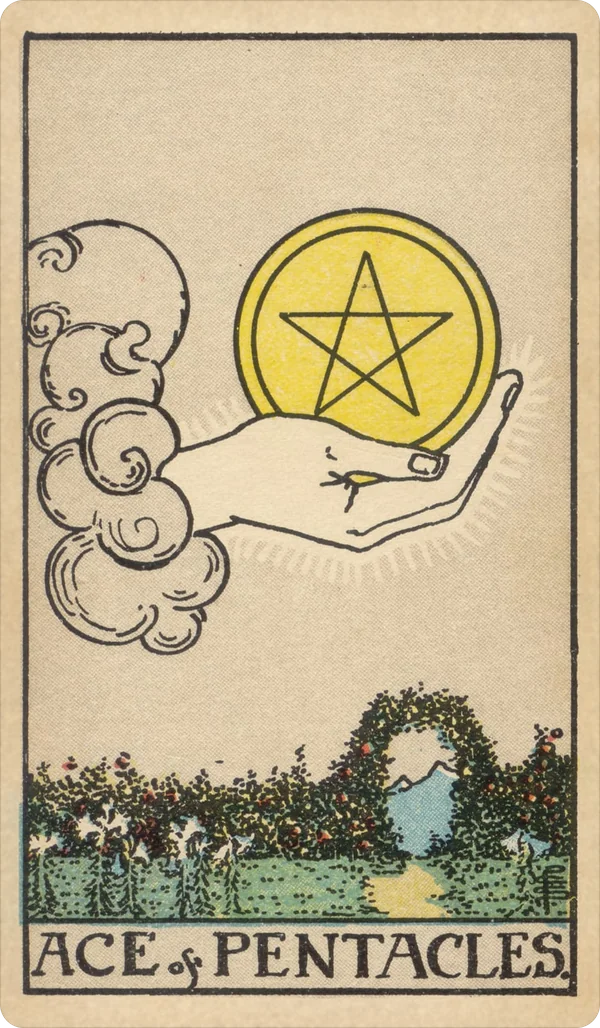
- Ten of Pentacles and Ace of Pentacles
The Ace is the seed and the Ten is the estate. Together they invite you to connect a small start today with the long-term life it might help build.
- Ten of Pentacles and Ten of Cups
With the Ten of Cups, material stability meets emotional joy. The pair describes a home life that feels both secure and loving.
- Ten of Pentacles and The Hierophant
The Hierophant brings tradition and shared rules. Next to the Ten of Pentacles, it asks which family or cultural traditions you want to honor and which you want to question.
- Ten of Pentacles and Ten of Swords
With the Ten of Swords, a long chapter may be ending painfully. Together they suggest looking at old family patterns that are ready to be laid to rest.
The most common misreading of Ten of Pentacles
One idea that keeps circulating is that the Ten of Pentacles means you are going to inherit money or marry into wealth. Beginners often see the estate and the coins and jump straight to an inheritance. The card is really about legacy in a much wider sense: values, roots, family patterns and long-term stability. There is also the idea that it only applies to traditional families. Chosen family, close friends and communities all fit inside its archway.