Four of Pentacles Tarot Card Meaning
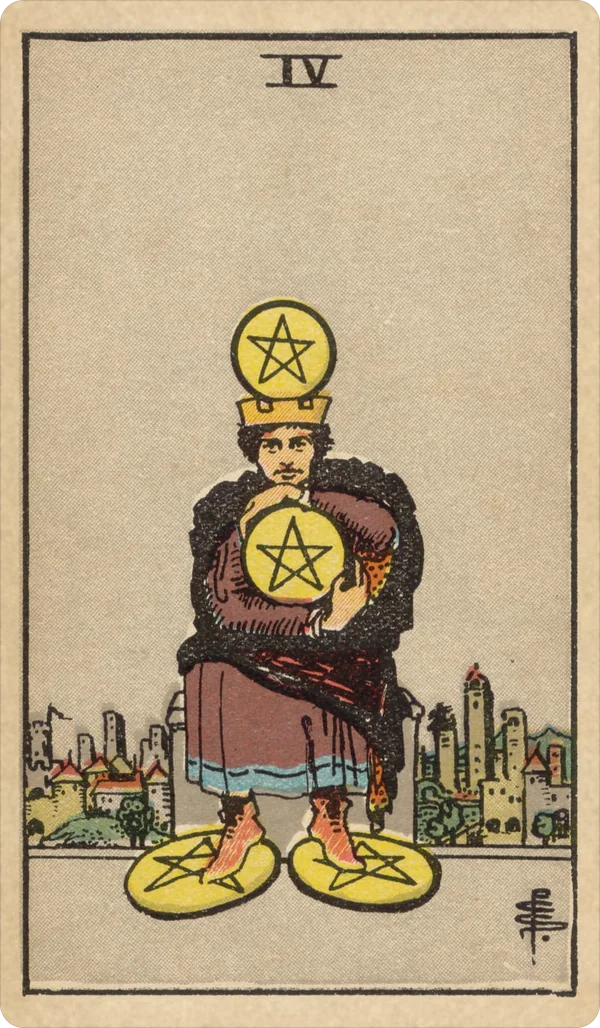
Four of Pentacles
Pamela Colman Smith, 1909
- Upright
- security · conservation · control
- Reversed
- possessiveness · scarcity fears · letting go
- Arcana
- Minor · Pentacles
- Element
- earth
- Learn it in
- Day 24 of the 30-Day Tarot Path
In short
The Four of Pentacles is the card of holding on. A crowned figure hugs one coin, balances another on his head and plants his feet on two more. Upright, it can mean healthy saving and solid boundaries. It can also mean gripping so tightly that nothing new gets in. Reversed, the grip loosens, for better or worse.
What you see on the Four of Pentacles card
Look first, read later: this is the Image-First Method from Day 5 of the course. Start with what is actually in the picture.
- Figure
- A man with a small gold crown sits facing us, wrapped in a dark fur‑trimmed cloak over a purple‑brown robe.
- Action
- He clutches one coin tightly against his chest with both arms, keeps another balanced on top of his crown, and rests each foot on a coin lying flat on the ground.
- Setting
- Behind him, a whole city of towers and red roofs stretches along the horizon, and he sits with his back to it.
- Color
- A wide plain gray sky fills most of the card, which makes the figure look isolated and the four gold coins look heavy.
- Detail
- His body forms a closed shape: arms locked, knees together, feet pinned down. Every coin is touching him, and none is free.
Four of Pentacles upright meaning
Four is the number of structure, the four walls and four corners that make something stable. After the juggling of the Two and the teamwork of the Three, the Four of Pentacles stops and secures what has been built. On its good days, this is the card of a savings habit, a lease you can afford, and the confidence of knowing your basics are covered.
But Smith drew a figure who looks anything but relaxed. He holds one coin like a shield over his heart. Another sits on his crown so he cannot even turn his head without risking it. His feet are trapped on the last two. He has turned his back on the city, which is full of people, trade and movement.
So the upright card asks a careful question: is your security giving you freedom, or costing it? Holding on is wise when you are protecting something that matters, such as your time, your energy or a boundary that keeps you well. It becomes a cage when fear decides everything and every new person or idea looks like a threat.
In a daily pull, notice what you are clutching to your chest today, and whether you could hold it a little more loosely without losing it.
Four of Pentacles reversed meaning
In the reversed position, the Four of Pentacles shows the arms opening. That can be wonderful: you finally share, spend on something meaningful, delegate a task or let someone into a part of your life you kept guarded. Generosity and trust come back.
It can also tip the other way. Letting go suddenly, after holding tight for too long, can look like overspending, oversharing or dropping a boundary you still need. The card invites you to look for the middle path. What is safe to release, and what still deserves protection? A loosened grip is healthiest when it is a choice and not a collapse.
Four of Pentacles in love and relationships
Upright in love
In love, the Four of Pentacles often points to guardedness. You may be holding your feelings close, slow to trust, or protecting your independence so firmly that a partner cannot get near. In a long-term relationship it can show possessiveness or a fear of change that keeps things frozen. None of this comes from a bad place. Usually it comes from past loss. The card asks you to notice what you are protecting, and whether your person is actually the threat you are guarding against.
Reversed in love
Reversed in love, the coins start to move. You might be opening up after a long time of keeping walls high, or finally letting a partner see the parts of you that you hide. It can also point to loosening control in a relationship, like giving someone space instead of tracking their every move. The reflection here is gentle: what would it feel like to share a little more, and what support would make that feel safe?
Four of Pentacles as feelings
The Four of Pentacles as feelings describes protective, careful emotion. There may be strong attachment, but it is held close and rarely shown. Rather than treating this as a statement about another person, Tarot Habit asks you to notice the feelings moving through the connection. Is there a fear of losing something? A wish to keep things exactly as they are? Sometimes the deepest care hides behind the tightest grip, and naming that out loud can soften both sides.
Four of Pentacles in career and money
In your working life, the Four of Pentacles can describe guarding your position, your methods or your information. Upright, it can be healthy: protecting your focus, saying no to extra projects, building a cushion of time and energy. In excess, it becomes hoarding knowledge, refusing to train others or resisting any change to how things are done. With money habits, it points to saving and caution. The card invites you to check whether your caution is serving your goals or keeping you from growing.
The shadow side of Four of Pentacles
The hidden edge of the Four of Pentacles is control born from fear. It whispers that if you hold tightly enough, nothing bad can happen. Many people with this pattern grew up with real scarcity, and the grip made sense once. Shadow work means asking where that old fear still runs your choices. Do you keep score in friendships? Struggle to accept gifts? Feel panic when plans change? Notice that the figure on the card has turned away from the whole city in order to guard four coins. Ask yourself what connection, adventure or rest you are giving up to keep things the way they are, and whether the trade still feels worth it.
Four of Pentacles in yes-or-no questions
Tarot Habit does not ask the cards for yes or no. The Four of Pentacles is about the quality of your grip, so the question works best when it explores what you are holding and why.
Instead of
“Should I hold on to what I have?”
Try
“What am I protecting right now, and what would I gain or lose if I held it a little more loosely?”
Four of Pentacles as advice
As guidance, the Four of Pentacles says: know what you are guarding, then decide on purpose. Keep the boundaries that protect your health and peace. Loosen the ones that only protect old fear. Try one small act of openness this week, like sharing a resource, a skill or an honest feeling.
Journal prompts for Four of Pentacles
- What am I holding against my chest right now, and what am I afraid would happen if I let it go?
- Which of my boundaries protect me, and which ones mostly keep good things out?
- The figure on the card has his back to the city. What part of life have I turned away from in order to feel safe?
Four of Pentacles with other cards
- Four of Pentacles and Six of Pentacles
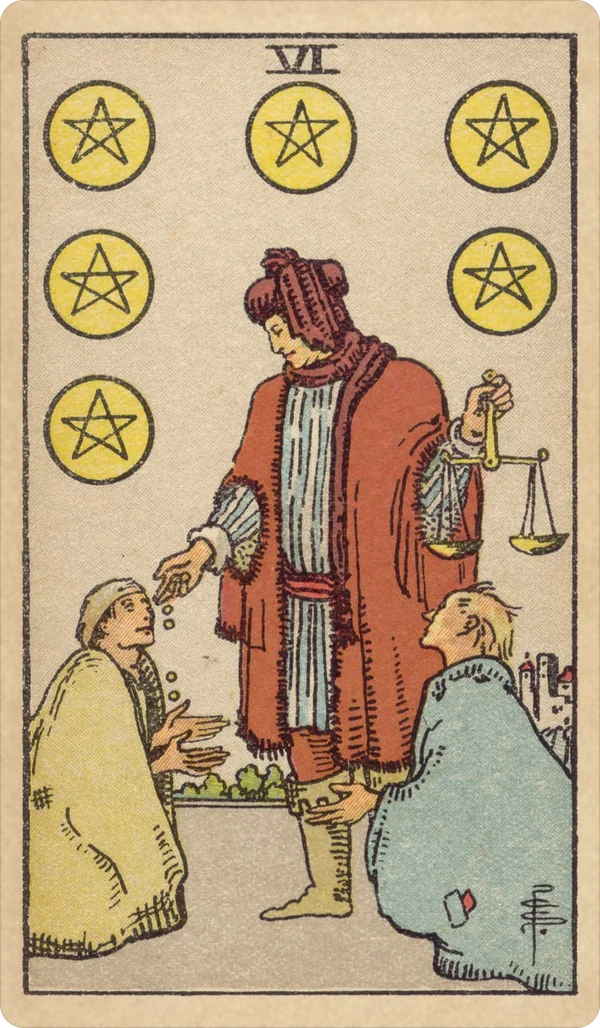
Followed by the Six of Pentacles, the clutched coin starts to circulate. Together they ask how to move from guarding resources to sharing them fairly.
- Four of Pentacles and The Emperor
With The Emperor, both cards sit facing forward on a fixed base. The pair stresses structure and control; ask whether your rules are protecting you or boxing you in.
- Four of Pentacles and Eight of Swords
The Eight of Swords shows a figure bound by her own thoughts. Next to the Four of Pentacles, notice how fear of losing something may be keeping you stuck.
- Four of Pentacles and Two of Cups
With the Two of Cups, the guarded heart meets an open offer of connection. The question becomes whether you can let someone in without losing yourself.
The most common misreading of Four of Pentacles
A very common beginner myth is that the Four of Pentacles simply means being greedy or stingy. That view is harsh and incomplete. The card can describe healthy saving, financial caution after hard times, or a needed boundary. Some beginners also assume the reversal is always good because it means letting go. Letting go can also mean overspending or giving up protection you still need. The key is always the quality of the grip, not just whether it is tight.