Five of Pentacles Tarot Card Meaning
Five of Pentacles
Pamela Colman Smith, 1909
- Upright
- hardship · exclusion · insecurity
- Reversed
- recovery · finding help · reconnection
- Arcana
- Minor · Pentacles
- Element
- earth
- Learn it in
- Day 24 of the 30-Day Tarot Path
In short
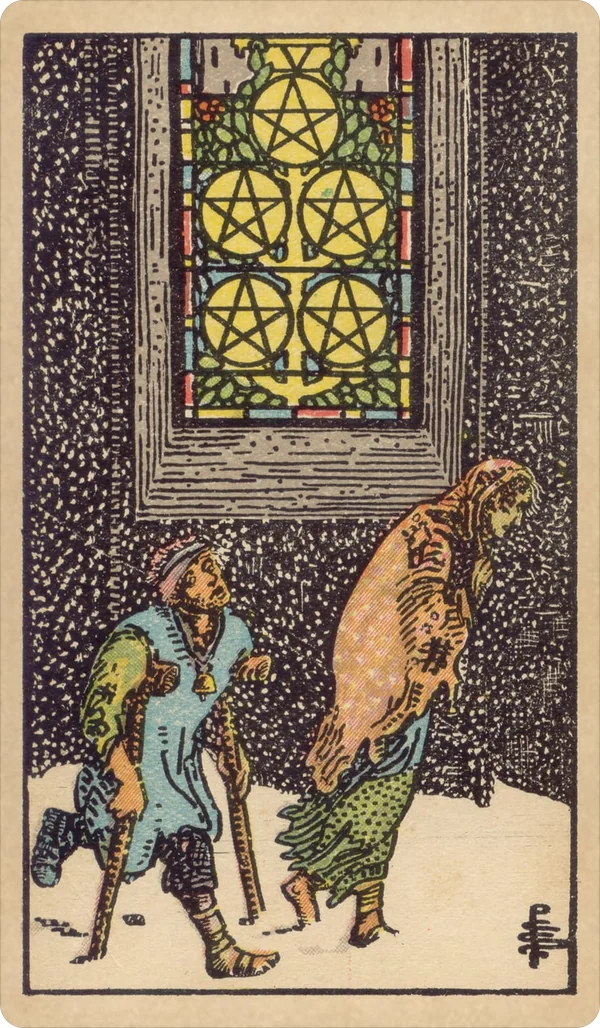
The Five of Pentacles shows two people walking through snow past a glowing church window. It is the card of hard times: money stress, illness, or feeling shut out. Upright, it names the struggle honestly. Reversed, it points to recovery and help arriving. Its quiet message is that warmth may be closer than it looks.
What you see on the Five of Pentacles card
Look first, read later: this is the Image-First Method from Day 5 of the course. Start with what is actually in the picture.
- Figure
- Two ragged people move through the cold. One is a man on two wooden crutches with a bandage around his head; the other is a woman wrapped tightly in a pink‑orange shawl, her head bowed.
- Action
- They trudge past a building without looking up. The man glances sideways, but the woman stares down at the snow as she walks barefoot.
- Setting
- Snow covers the ground and heavy white flakes fall against a black night sky. A stone wall rises behind them with a single tall window.
- Color
- The stained‑glass window is the only bright, colorful spot on the card: gold coins, green vines and red and blue panes, glowing above the dark street.
- Detail
- The man wears a small bell on a cord around his neck. In older times, people with certain illnesses had to carry a bell, which suggests he is not only poor but also pushed away by others.
Five of Pentacles upright meaning
Five is the number of disruption in every suit, the point in the story where stability breaks. In the suit of earth, that break is physical and material. Smith shows it plainly: two people in rags, barefoot or on crutches, out in a snowstorm at night.
The upright Five of Pentacles can describe money worries, job loss, a health problem, or the lonely feeling of being on the outside of a warm room. It does not sugarcoat this. Hardship is real, and the card gives you permission to admit it.
Yet the most important detail is above their heads. A lit stained-glass window glows right behind them, and neither figure looks at it. The picture holds a quiet question: where is help available that you have not noticed or have not felt allowed to ask for? Pride, shame and exhaustion can keep people walking past the very door that could shelter them.
The card also shows two people, not one. Even in a hard season, someone may be walking beside you. When this card appears in a daily pull, it invites you to name the struggle, then look around for the light in the window, even a small one, like a friend, a resource or a single kind act.
Five of Pentacles reversed meaning
When it lands reversed, the Five of Pentacles suggests the worst of the cold is passing. You might be finding help, getting back on your feet after a loss, or finally accepting support you had refused. The window has been noticed, and someone has knocked.
It can also point to an inner shift: a scarcity mindset softening, or a sense of exclusion fading as you reconnect with people. Recovery is often slow and uneven, and the card does not demand that you feel fine right away. It invites you to notice even small improvements and to give yourself credit for getting through. A warm meal, a returned call or one good night of sleep all count as progress.
Five of Pentacles in love and relationships
Upright in love
In love, the Five of Pentacles can describe a relationship going through a hard stretch together, like money stress, illness or a move that leaves both partners worn out. It can also point to feeling left out in the cold by a partner, or loneliness while single. The card asks you to notice whether you and your person are walking through the snow side by side, or each alone. It also invites you to ask for warmth directly, instead of hoping someone will notice.
Reversed in love
Reversed in love, this card points to warmth returning. A couple might be coming through a hard season with more trust, or you might be reconnecting with someone after a period of distance. For people who have felt unlovable or excluded, it can mark the moment you begin letting others in again. The card invites you to notice who offered shelter when things were bad, and what you learned about the kind of care you need.
Five of Pentacles as feelings
As feelings, the Five of Pentacles carries insecurity, worry and sometimes shame. There can be a sense of not being enough, or of being shut out. Tarot Habit uses this as a prompt to notice the feelings in the connection, not to guess at what someone else secretly thinks. Are you or the other person feeling left out, unsupported, or too proud to ask for help? Feelings like these often hide behind silence, so naming them gently can open a door.
Five of Pentacles in career and money
At work, the Five of Pentacles can show a layoff, a lean season for a small business, or feeling ignored by your team. It honors how stressful that is. The card's practical nudge is to look for help you have not used yet: a former colleague, a community program, a mentor, a skill you can refresh. With money habits, it invites you to look honestly at the numbers without self-blame, and to reach out for support. It does not offer financial advice, only the reminder not to walk past the window alone.
The shadow side of Five of Pentacles
Look at the Five of Pentacles from its shadow side and you find the belief that you do not deserve help. Some people, especially those who are used to being the strong one, would rather freeze than knock on a door. Others feel so ashamed of struggling that they hide it from everyone. As a shadow prompt, the card asks you to look at your relationship with need. Who taught you that asking was weakness? When have you walked past a lit window because you assumed it was not meant for you? The figures on the card are not barred from the church; they simply do not look up. Notice where your own eyes are fixed on the snow.
Five of Pentacles in yes-or-no questions
Tarot Habit does not give yes-or-no answers about money, health or hardship. The Five of Pentacles is about noticing help and naming struggle, which an open question can actually do.
Instead of
“Is my money situation going to get better?”
Try
“What support is available to me right now that I have not reached for, and what small step could I take toward it?”
Five of Pentacles as advice
As advice, the Five of Pentacles says: look up. Name what is hard, then look for the lit window, whether that is a friend, a hotline, a community group, or a professional who can help. Asking is not failure. And if you are warm right now, notice who might be walking outside.
Journal prompts for Five of Pentacles
- What hardship am I carrying quietly right now, and who have I not told about it?
- Where is the lit window in my life, the help or warmth I keep walking past?
- What did I learn growing up about asking for help, and how does that lesson show up for me today?
Five of Pentacles with other cards
- Five of Pentacles and Six of Pentacles
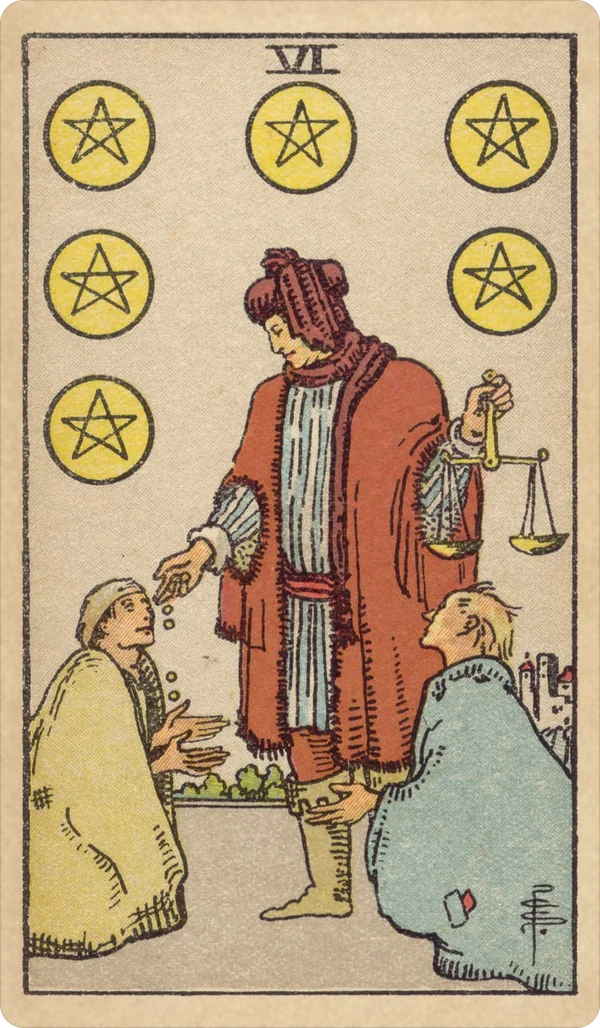
The Six of Pentacles follows the Five in number and in story. Together they show hardship meeting generosity, and ask whether you are ready to receive or able to give.
- Five of Pentacles and The Star
With The Star, the cold night gives way to quiet hope. The pair points to healing after a hard season, one small step at a time.
- Five of Pentacles and Nine of Swords
Next to the Nine of Swords, the worry has moved into sleepless nights. Notice how much of the struggle is outside you and how much is being replayed in your head.
- Five of Pentacles and Three of Cups
With the Three of Cups, the loneliness of the Five meets friendship and community. Together they suggest leaning on the people who already care.
The most common misreading of Five of Pentacles
The most common beginner myth is that the Five of Pentacles means financial ruin is coming. People pull it and panic. The card describes a hard moment, not a permanent state, and it always includes the glowing window as a reminder of available help. A second mistake is treating it as purely financial. In the 1909 image, one figure is clearly injured or ill, so the card speaks just as much to health, exclusion and loneliness.